The Water Cycle Is Not a Loop with One Starting Point
The water cycle has no single starting point. See how water moves through soil, plants and air, and read diagrams without mistaking them for fixed routes.
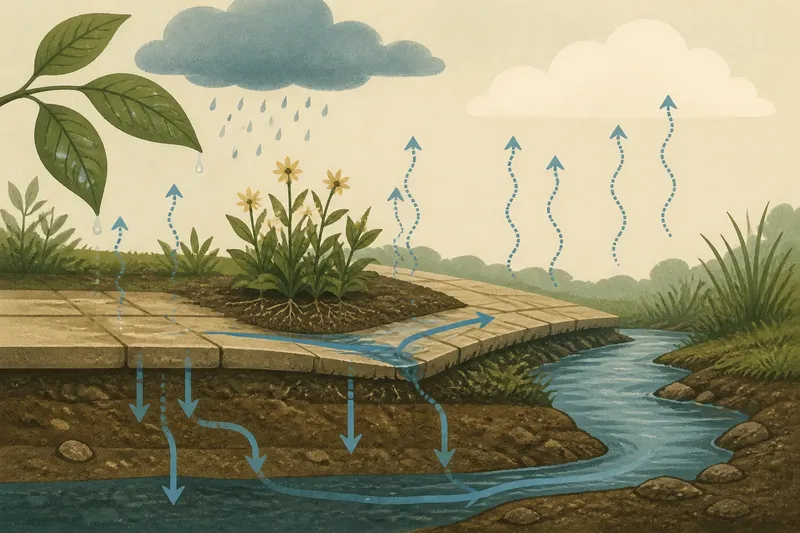
Water cycle diagrams often draw an arrow from the sea to a cloud and another from the cloud to the land. But the puddle beside your gate may be drying as rain sinks into the flower bed, and neither scene tells you where the water cycle began. The water cycle is better understood as connected movements than as a loop with one starting point.
Why does the water cycle have no starting point?
Water moves between the atmosphere, land, living things and bodies of water. Rain can fall onto a leaf, soak into soil, run into a stream or collect in a hollow. Water in each place may later move along a different route.
Even rain is not a true beginning: before it fell, its moisture was in the atmosphere, and before that it may have come from many places. Starting a drawing with evaporation is simply a convenient way to explain one part of the system, not a rule that every drop follows.
How does water move through soil and plants?
After rain, some water runs over the surface towards a stream. Some enters the ground through infiltration, clings to soil particles or drains deeper. A plant may take up water through its roots and release some of it as vapour through its leaves; this is called transpiration.
Water underground can move through soil and rock, remain there for a time, or eventually feed a spring or stream. What happens depends on local ground, slope, plants and weather. A dark patch of soil is a visible clue that rain reached the ground, but it cannot show the water’s entire route.
Water at an exposed surface can also evaporate, changing from liquid into vapour that mixes with the air. This happens at wet soil, leaves and streams as well as at larger bodies of water. Evaporation and transpiration both add water vapour to the atmosphere, but they describe different routes.
How does water in the air return as precipitation?
When moist air rises and cools, water vapour can condense into tiny droplets or ice crystals. These may form part of a cloud, but a cloud is not a sealed parcel of water with one known source. Moving air brings moisture from different places.
If droplets or ice crystals grow enough to fall, precipitation reaches the ground as rain, snow, sleet or hail, depending on conditions. Some of it may return to the air from a wet leaf; some may enter soil, and some may flow towards a stream. Condensation does not always lead to rain: clouds can change or disperse without producing precipitation.
What can you observe without guessing the whole route?
Everyday observations can help you notice possible pathways. Think of them like marks on a map: useful for understanding the nearby terrain, but not a complete record of every journey.
- Ground after rain: If water collects in a hollow, then note where the low point lies; if it begins to drain, watch whether it moves towards a drain or a stream, otherwise consider that it may remain pooled or soak into the ground.
- Soil beside a path: If loose soil darkens after rain, then infiltration is a possibility; if water instead travels across a hard path, then look for where that runoff goes, otherwise avoid assuming from colour alone that water has reached deep groundwater.
- Leaves after a shower: If water remains on a leaf, then it may evaporate or drip to the ground; if the leaf appears dry later, that change does not reveal which route occurred, so keep both possibilities open.
- A stream edge: If surface water visibly flows into the stream, then runoff is reaching it; if the bank looks wet without visible flow, do not infer the direction of underground movement and instead describe only what you can see.
- Clouds above a wet area: If clouds gather, then condensation may be occurring; if they pass without rain, remember that cloud alone does not show where its moisture came from or where it will go.
- A drying puddle: If its edges retreat on a dry, breezy day, then evaporation is one possible cause; if water also drains into the ground, the surface change cannot distinguish the two, so treat both as plausible.
Say a garden path has a shallow dip beside a flower bed after a shower. You see water moving off the paving into the dip, while nearby soil is dark and the leaves hold droplets. The paving offers an observable runoff route; the soil and leaves suggest other possible routes, but you cannot tell by sight whether water has reached groundwater or how much has evaporated. The useful answer is therefore a set of plausible pathways, not a claim about one drop’s full journey.
What do people ask about the water cycle?
Does every drop pass through the ocean?
No. Water can move among land, plants, soil, groundwater and the atmosphere without passing through the ocean. The ocean is a major part of the water cycle, not a compulsory stop for every portion of water.
Is evaporation the same as transpiration?
No. Evaporation is water changing into vapour from an exposed wet surface, while transpiration is water vapour released by plants, mainly through their leaves. Both move moisture into the air.
Does condensation always produce rain?
No. Condensation can contribute to clouds, mist or dew, and clouds may disperse without rain. Precipitation forms when water or ice particles in clouds grow enough to fall.
Can you trace where a raindrop will go?
You can identify likely routes by observing slope, ground, plants and nearby water, but you usually cannot follow one drop through the whole system by sight. It may run off, soak in, enter a plant or return to the air, depending on local conditions.
How should you read a water-cycle diagram?
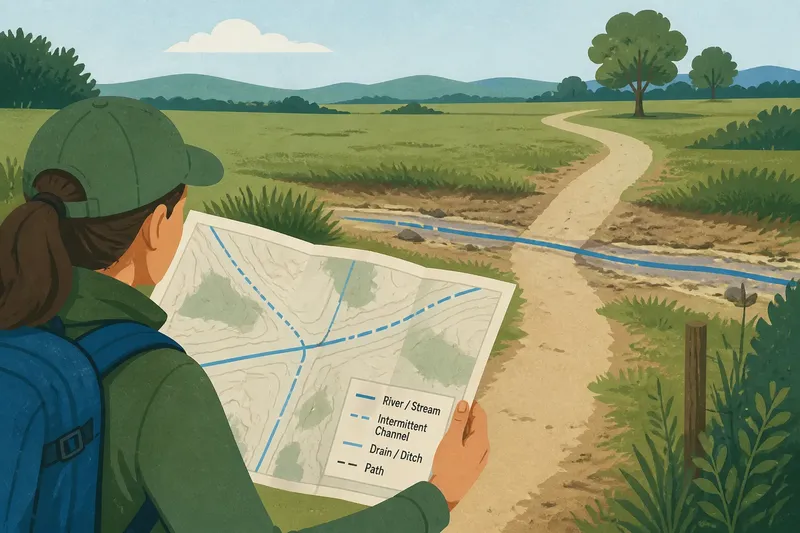
Read a diagram as a map of processes, not a timetable. Arrows may show evaporation, transpiration, condensation, precipitation, runoff and infiltration. Check which routes are included: some diagrams emphasise clouds and oceans, while others show groundwater or plants more clearly.
Infiltration means water entering the ground; runoff is water flowing over land; condensation is water vapour becoming liquid droplets or ice. These terms name changes and movements, not fixed stages that every drop must pass through in order.
When you search for the water cycle’s starting point, the most useful answer is that there is none: the diagram’s first arrow is a teaching choice. Follow any visible clue—a wet leaf, a stream or a cloud—and keep the difference between an observed change and an assumed journey in view.