Marsh, Fen or Swamp? A Reader's Comparison
Marsh, fen or swamp? Compare water sources and vegetation to describe a wetland more clearly and understand why its local name may differ.
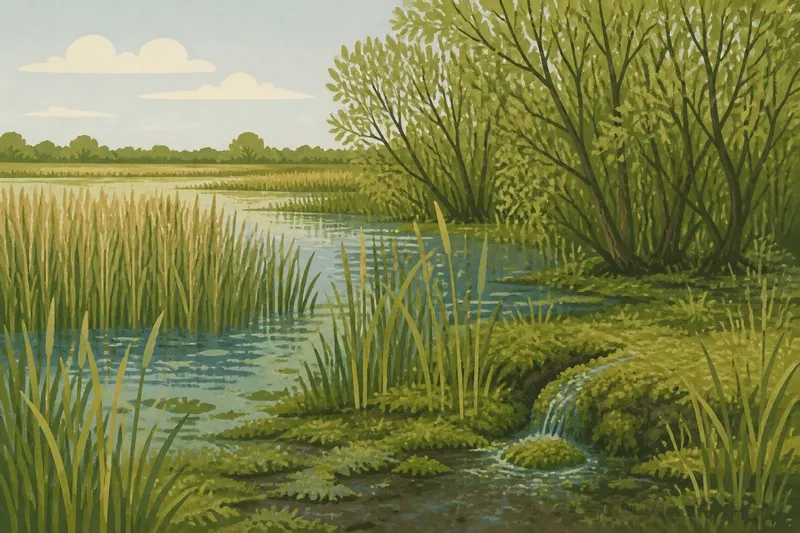
At the edge of a reed bed, the ground gives way to a pool while willows crowd the bank. If you are comparing a marsh, fen or swamp, start with two questions: what grows there, and how does water reach it? Those clues help explain the names, even when a site does not fit neatly into one category.
What makes a marsh look open and grassy?
A marsh is generally an open wetland dominated by soft-stemmed plants such as reeds, rushes and sedges. Shallow water may show between the plants, or the soil may simply stay saturated; conditions can change with rain and season.
Marshes occur beside rivers and lakes, along coasts and in inland basins. Their water may arrive through rainfall, streams, river overflow or groundwater, so the word describes the habitat’s broad character rather than a single water source.
When you stand at a marsh edge, look for broad stretches of non-woody growth and patches of open water. A few trees at the margin do not change the overall impression if soft-stemmed plants dominate the wet ground.
Why does groundwater matter in a fen?
Fens are commonly peat-forming wetlands influenced by groundwater moving through soil or rock. That water can carry dissolved minerals, which in turn shape the plants able to grow there. The seepage may be subtle, with no visible spring or channel.
Fens often support low-growing plants, including sedges, grasses, mosses and wildflowers. A single species cannot settle the identification: plant communities and water supply are more useful together than any one familiar plant.
Do not assume every fen has the same water chemistry. Conditions vary, and a general label cannot tell you exactly what is dissolved in the water or how it reaches the surface.
What gives a swamp its woody character?
A swamp is usually recognised by prominent trees or shrubs growing in wet ground. It may contain standing water, waterlogged soil or both, and its water can come from rain, groundwater, a lake or a river.
Some swamps are wooded; others have dense shrubs. Willows are one possible sight in a freshwater setting, though the plants depend on the region. Open pools, grassy clearings and channels may break up the woody cover.
The difference between a swamp and a marsh is often easiest to see in the dominant vegetation: woody growth in a swamp, soft-stemmed plants in a marsh. At their edges, those patterns can blend rather than stop at a sharp line.
How can you compare a marsh, fen and swamp?
Use the observations below to choose a careful description, not to claim a formal classification. The same wetland can contain several habitats, and local authorities may apply more specific definitions.
- Check the dominant growth: If trees or shrubs cover much of the wet area, describe it as swamp-like; if soft-stemmed plants dominate open ground, describe it as marsh-like. If neither pattern is clear, name the plants and patches you can see instead.
- Check for open pools or channels: If water lies between reeds or rushes, note the open-water and soft-stemmed pattern; if the ground is wet without visible pools, record saturated soil instead of ruling out a wetland type.
- Check for seepage signs: If water appears to move slowly through the ground and low-growing plants occupy peat-like wet soil, consider fen as a possibility; if the source is not evident, avoid assigning the name from vegetation alone.
- Check whether the habitat changes across the site: If open and wooded patches sit side by side, describe each separately; if one pattern clearly dominates, use that pattern for a broad description.
- Check the site’s own wording: If a reserve sign or conservation authority names the habitat, use that name when reporting the site; if its wording is broad or absent, give your plain-language observations as well.
- Check the purpose of your notes: If you are writing informally, a phrase such as “reed-filled wetland with a wooded edge” may be enough; if the record needs a formal habitat class, consult the relevant local guidance rather than guessing.
Say you reach an invented wetland where reeds fill an open centre, willows line one side, and water seeps across a small patch of soft ground. First, you note the reeds and open water; next, you record the woody margin separately; then you add that seepage is visible only in the small patch. Your resulting description is “open marsh-like centre, wooded edge, local seep-fed patch”; the trade-off is that it is more precise than one label, but does not claim the whole site is a fen or swamp.
Why might one wetland have more than one name?
People use wetland terms at different scales. A neighbour may call a reed-filled hollow a marsh, while a site manager may distinguish several habitat types within it. Maps and local speech may also follow different naming conventions.
Wetlands are not always tidy compartments. A fen may include pools or shrubby edges, and a swamp can open into marsh. The vegetation and water can also shift with seasons, so the same place may look different on another visit.
For a school project or habitat record, pair any label with what you observed: the dominant plants, visible water and changes across the site. If the task requires a formal classification, use the relevant reserve or local conservation authority’s definitions.
What do people mean by marsh, fen and swamp?
Is a fen always fed by groundwater?
Groundwater commonly influences fens, but a visible spring is not required. Seepage may move slowly beneath or across the ground.
Can a marsh have trees?
Yes. Trees may grow along its edges or in scattered patches; marsh usually describes a wetland where soft-stemmed plants remain the dominant growth.
Is a swamp always covered by standing water?
No. A swamp may have pools or channels, or just waterlogged soil. Its appearance can change with rainfall and season.
Are these names used the same way everywhere?
No. Regional speech, maps and conservation classifications can draw the boundaries differently. If the label matters, follow local guidance and add a plain description of the plants and water.
For a quick comparison of marsh, fen and swamp, keep the strongest clues in view: open soft-stemmed growth, groundwater influence, or prominent woody plants. When those clues overlap, recording the separate patches gives a clearer account than forcing the whole wetland into one name.