A Rainy-Day Window Watch for Water in Motion
A rainy-day window watch reveals how water moves from glass to ground, helping you notice changing routes across leaves, paving and garden soil.
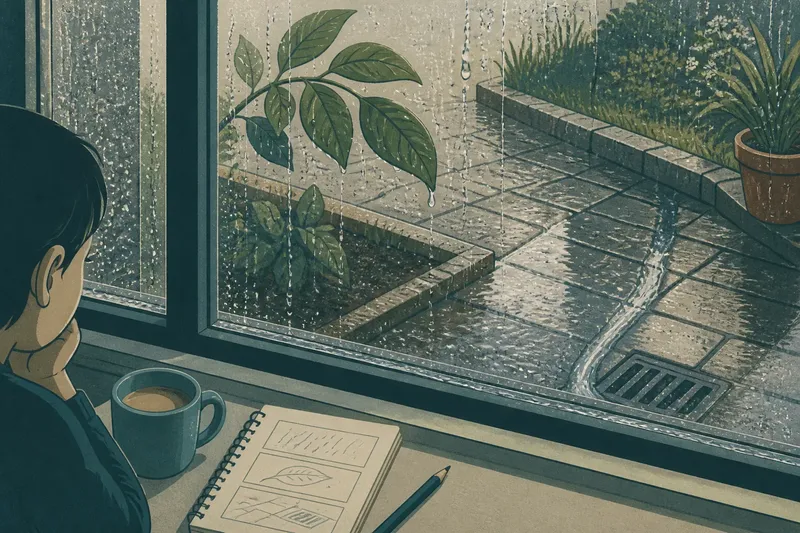
Where does rain go after it touches your window? A rainy-day window watch lets you follow the visible journey from glass to ground, without needing to track a single drop from start to finish.
Choose a dry indoor seat with a view of a sill, a patch of paving or a garden bed. Rain turns these familiar surfaces into a changing scene: a bead stretches, a leaf sheds water, and a dark line appears along a path.
What can a window reveal about rain?
Look first at the outer surface of the pane. A drop may sit like a bead, lengthen into a streak, join another trail or slip out of sight. Pick a feature that is easy to recognise, such as a mark near the lower corner, and notice how it changes.
The frame can interrupt a trail, and the glass may not be perfectly even. Condensation on the room-facing side can blur the view, so note which surface holds the droplets before describing them as rain.
If the sill is visible, watch where water reaches the edge. It may collect in one spot or leave the glass along the frame. You can describe the change from pane to edge without guessing where the water goes next.
What happens when rain reaches leaves and paving?
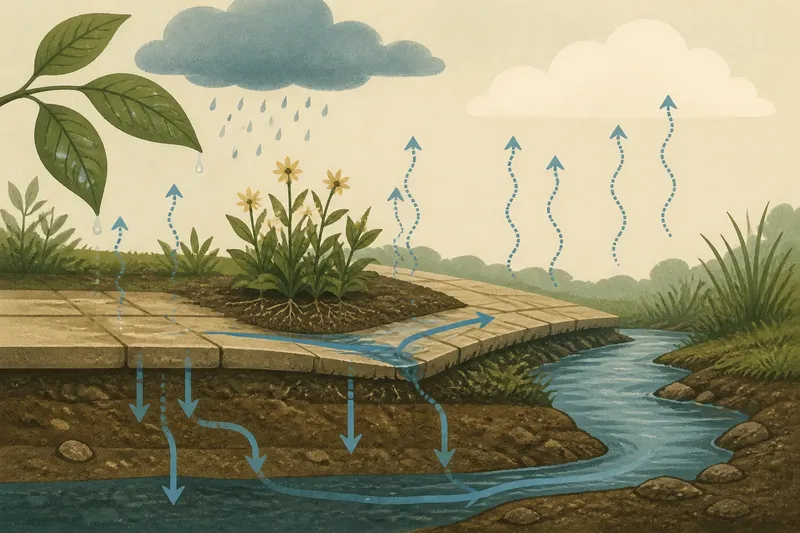
Shift your attention to a patch of ground. Paving may turn glossy, and water may gather in a shallow dip or follow a seam. In a planted bed, leaves can catch drops before they reach the soil; a drip may then fall from a leaf tip.
Look for a contrast between nearby surfaces. One patch of path may shine while the next remains dull, or water may collect beside a kerb. These details show where water is visible, not what happens after it disappears behind a planter or into a drain.
A sloping tray is a handy everyday analogy: water gathers at low spots and moves around raised edges. Gardens and paths have more uneven surfaces, so use the comparison to spot dips and barriers, not to predict an exact route.
How can you connect the visible parts of the route?
Choose a few landmarks: a trail on the glass, the sill or roof edge, and a patch of ground below. At each one, note whether water is gathering, moving, dripping or leaving view. This creates a small map of linked observations rather than a claim that one drop travelled the whole way.
Say you are looking from a kitchen window at rain on the pane, a leaf and a strip of paving. First, you note that a glass trail lengthens towards the lower frame. Next, you see a leaf drip onto dark soil and a bright line appear along the paving towards a grate. Your written result might be: “Trail reaches frame; leaf drips onto soil; paving shine approaches grate.” The route links separate things you can see, but does not establish that they are one drop.
Look at the same landmarks again when the rain eases. A puddle may shrink, a leaf may keep dripping, or a dark track may remain. Record what has changed and where the view ends; the scene need not provide a complete account of the water’s path.
What should a rainy-day window watch note include?
Keep the note short, with a surface, an action and a landmark. “Drops gather at the outer sill above the left-hand paving seam” is easier to picture than “lots of rain”. Use a sketch if several features overlap.
- Glass: If drops bead, streak or merge, note the change; if the pane is fogged, switch to a clearer visible feature or mark the glass route as unclear.
- Edges: If water reaches a sill or roof edge, note where it leaves view; if the edge is hidden, leave that part of the route unrecorded rather than filling the gap with a guess.
- Plants: If a leaf holds or sheds drops, describe the visible action; if foliage blocks the ground, choose a nearby landmark that remains in view.
- Ground: If paving looks glossy, dark or pooled, record the location; if its surface is obscured, note that you cannot see the ground clearly.
- Barriers: If water appears to meet a kerb, ridge or pot, note the visible change; if the route turns out of sight, stop the description at that point.
- Gaps in view: If a wall, plant or grate hides the next part, name where the route disappears; if the gap makes the scene hard to follow, focus on the pane or another unobstructed patch.
These choices keep the note grounded in what is visible. A sentence such as “Water reaches the planter; its route beyond is hidden” is complete, even without an explanation of what happens next.
Which questions help you look more closely?
Why do drops take different paths on one pane?
Small differences in the glass, its angle or the frame can affect where water gathers. Describe the paths you see without assuming that one detail explains every drop.
Can I follow one drop from the window to the ground?
The frame may hide the edge, and drops can join or fall beyond your view. Link observations where the connection is visible, then mark where it becomes uncertain.
What should I watch if the ground is hidden?
Follow what remains in view, such as water leaving the pane or dripping from a leaf. Note where the route disappears behind the obstruction.
Can children join a rainy-day window watch?
Yes: one person can watch the pane while another chooses a visible landmark and describes changes. Stay indoors, and let children draw or dictate a note rather than reaching through an open window.
How can you watch comfortably and safely?
Choose a dry indoor spot that does not require climbing, leaning out or opening a window. If the glass is fogged, watch the room-side condensation separately or use a clearer view; there is no need to handle a wet exterior surface.
A short look is enough to notice a change, such as a trail becoming a chain of beads or a bright patch spreading across paving. Stop if the view becomes unclear or you need to move away.
A rainy-day window watch is for noticing water’s visible route, not for judging a drain or predicting flooding. If you see water entering a building or creating an immediate hazard, leave the observation and alert a responsible adult, property manager or appropriate local service.
When you write down what you saw, end at the last visible point. That small boundary makes the note more useful: it tells you both how rain crossed the scene and where the view could not follow.